
KENT PREP
Blog
In 2025, The NYC SHSAT will be digitalized. But don’t worry. Keep calm and carry on.
In 2025, The NYC SHSAT will be digitalized. But don’t worry. Keep calm and carry on.
When the SAT transitioned to a digital format in 2023, the Kent Team anticipated that other admission tests—such as the Secondary School Admissions Test (SSAT), which had already adapted during COVID, and New York City’s Specialized High School Admissions Test (SHSAT) — would soon follow suit. As expected, starting this fall, rising 8th graders will take the exam in an entirely digital format.
However, one thing remains unchanged: the rigor of the test. The content will continue to assess and challenge students’ abilities at the same level as before.
The good news? While we may notice the shift, students taking the test for the first time will not feel the difference at all. Despite the change in test format, the age-old adage still holds: practice makes perfect.
And of course, behind every hard-working student are their equally diligent parents—our hats go off to you! Every year, we feel incredibly fortunate and proud to work with such dedicated Kent families, who all go far above and beyond simple test scores through the entire process.
We have witnessed parents overcoming initial challenges with their children, tracking steady progress, and prioritizing growth. Through fostering their children’s overall confidence in academics, they have emphasized the importance of strong study habits and the immeasurable value of dedication—efforts that have truly paid off!
With this concerted effort, here are 7 key points to help your 7th graders prepare for the upcoming digital-format NYC SHSAT and other admissions tests this fall:
- For 2025, the digital SHSAT will still be a 3-hour exam, testing ELA, with grammar and reading comprehension (57 questions), and Math (57 questions).
- Some questions will be replaced by tech-enhanced items (TEI), which provide alternative ways of answering a question, e.g., drag-and-drop. Students will also have a digital set of tools to help them through the exam.
- Paper exams will be available only for the extremely limited number of students who have IEPs or 504 Plans with approved testing accommodations that require paper versions in order for the students to access the exam.
- Take any assessment test and measure up against other students. Two fully functional online practice tests will be available online in the spring of 2025, according to the NYC Schools website. These will mirror conditions of the actual exams, so it will be worth familiarizing yourself and your children with the medium. We strongly advise combining these with the level of care and supplementary education you have already shown.
- Upgrade to 9th grade Reading and Math levels. Just like everyone has different interests and paces, do not feel beholden to your child’s current grade level. We are constantly surprised by how advanced your children are and by the skill they show, exceeding any standardized concept of “grade.” Do not be afraid to move ahead.
- Build knowledge with a variety of reading genres, and expand vocabulary. Find a genre which fascinates your child, then branch out and see where these works intersect in other genres and forms. Language is constantly evolving, and media literacy is fundamental in continuing growth into adulthood. The best way to prepare for any written section is to read as deeply and widely as possible. That’s not to say a 7th grader must delve into Hegel just yet, but building a repertory of thought-provoking literary works will foster their critical thinking skills. Research and analysis will be paramount to their academic lives moving forward. Exposing your children to that will leave them exponentially better prepared than others.
- Practice through digital mock exams. As stated above, NYC schools will make digital practice tests available through the resources on their site. A good tip would be to simulate test conditions as much as possible and identify areas your child may have difficulty in. These will become focal points for your journey.
The NYC Board of Education will release more information as we near the test date. The Kent Team will, of course, be here to guide and support you through this process. We greatly look forward to working together to enrich your child’s education and navigate the odyssey of applications and preparation.

“Change is inevitable in life. You can either resist it and potentially get run over by it, or you can choose to cooperate with it, adapt to it, and learn how to benefit from it. When you embrace change you will begin to see it as an opportunity for growth.”
— Jack Canfield, Motiovational Coach
“Was there anything more exciting in life than seeking answers?”
— Isaac Asimov, Prelude to Foundation
SAT or ACT ?

At competitive high schools like Stuyvesant in New York City, it’s common for students to excel on standardized tests such as the SAT and ACT. With the ACT recently announcing changes to its test structure and score breakdown for 2025, it’s essential to understand how these updates may impact test-takers.
So, how does ACT work?
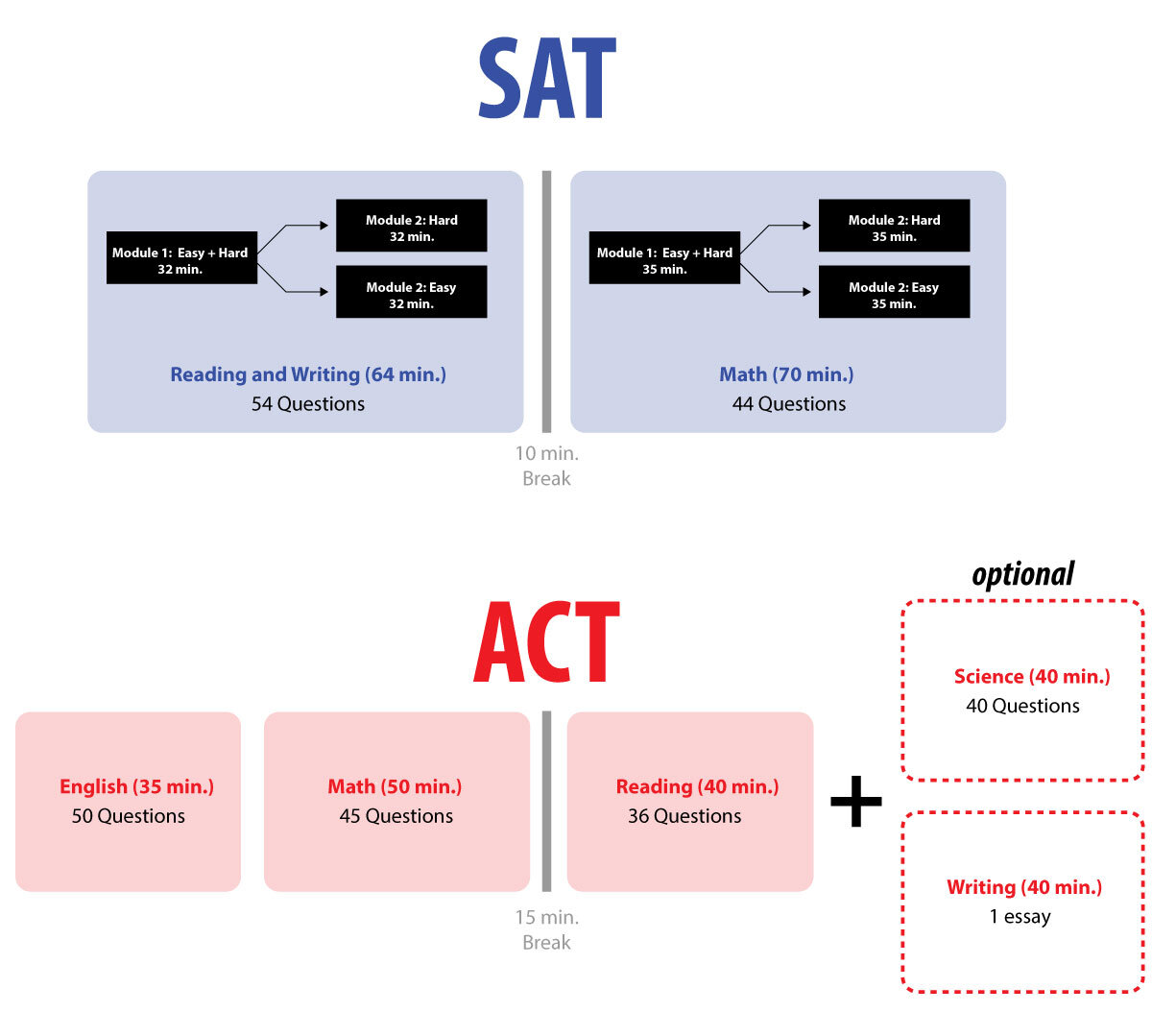
The ACT has traditionally consisted of four sections—English, Mathematics, Reading, and Science—each scored on a scale of 1 to 36, with a composite score reflecting the average.
While the details of the 2025 changes are still emerging, updates like these are typically designed to better align the test with current educational standards and college readiness benchmarks.

Optional Science Section
The ACT has allowed for the science section to no longer be mandated in a composite score breakdown and has shifted it to an optional model. The new ACT Composite scores will now be calculated using just the EMR (English, Math, and Reading) Sections. The science section, along with the writing section, can be added depending on the student’s request.
This grants students the flexibility to choose which sections reflect their competencies best. For instance, if a student is applying for an engineering degree, it would benefit them to take the ACT with the science section to showcase their talents in STEM.

Score Breakdown
Because the Science section is no longer part of the composite score, the ACT has divided up scores to either be ELA or STEM.
Students who choose to take:
- the science section will receive a STEM score (Math + Science)
- the writing section will receive an ELA score (English + Reading + Writing)
- both Science and Writing will receive both STEM and ELA scores
All students who test for the ACT will receive their Composite Exam score regardless of which section they choose to add. Individual science & STEM scores will continue to be reported for students who choose to take the science section but not included in Composite score calculations
Shorter Exam Time
Initially what was a 3 hours and 15 minute exam, the ACT has now been reduced to a 2 hour and 5 minute exam (without counting the science section) The mandated section times have each been reduced to
- English: 75 Q / 45 Min -> 50 Q / 35 Min
- Math: 60 Q / 60 Min -> 45 Q / 50 Min
- Reading: 40 Q / 35 Min -> 36 Q / 40 Min
This means that the student experiences more time per question.
For those who decide to take the science section, the change is listed as follows:
- Science: 40 Q / 35 min -> 40 Q / 40 Min
The essay portion remains the same with 1 Writing prompt taking 40 minutes.
Sectional changes
The Math section shifted from a 5 answer choice model to a 4 choice answer model. Additionally, English and Reading sections have shorter passages alongside their questions.
ACT vs SAT?
With a shorter test and the removal of a mandatory science section, the test has become similar to SAT Structure. However, there are still key differences that may impact a student’s choice to take one exam over the other.
- Paper option available: digital testing is not mandatory and students can choose to take a written test on paper
- The ACT remains a streamlined, non adaptive exam, meaning that the content of questions will not increase in difficulty as the SAT does.
- Tailored testing experience: For students who lean more verbally or mathematically, the ACT is a chance to emphasize their testing strengths more without emphasizing their weaknesses.
What does this mean for us?
At Kent Prep, students begin their PSAT preparation at the start of 8th grade. This early start helps them build a strong foundation in content knowledge and develop an advanced understanding of the subject matter. Mastering fundamental skills in reading, grammar, and math—which may not be taught until 10th grade in some high schools—is crucial for achieving top scores, such as a 1500+ on the SAT or a 35+ on the ACT.
Once students have mastered the necessary skills, the next step is determining which test—the SAT or ACT—best suits their strengths. While both exams cover similar content, they differ in format and structure.
With the upcoming changes to the ACT, we will provide students with opportunities to take practice tests, allowing them to assess which exam aligns better with their abilities and test-taking style. By this stage, students will have developed the awareness and confidence needed to approach either test strategically, maximizing their scores while saving valuable time and energy. This ensures they achieve their personal best, positioning them for success in the college admissions process.
If you would like to speak with a Kent Prep consultant about exam preparation, please fill out the inquiry form. We offer complimentary teleconferences for parents worldwide, providing personalized consultations available from 10:00 AM to 5:00 PM EST.
5 Study Strategies for Mastering Statewide Exams
Exams can be intimidating, but with the right strategies, you can conquer them with confidence- even from the third grade! We will share some tips that’ll pave your way to success in statewide exams. No matter your starting point, these methods can help fine-tune your study skills and prepare you for top performance on exam day.

1. Creating a Study Schedule
Organize your time with a solid study schedule. Allocating specific time slots for each subject helps maintain discipline and ensures you cover all necessary material. Kent utilizes a reliable curriculum that encompasses all subjects on standardized tests. By doing this, you’re not just prepping academically, but mentally conditioning yourself to handle the workload.
Flexibility is key; life is unpredictable, and your schedule should adapt to it. If you ever miss a class or cannot attend a session, we will provide the work for that missing day in advance or provide it for you when requested. Consistency fosters efficiency, and soon enough, adhering to your schedule will become second nature, leading you seamlessly towards success.
2. Choosing the Best Study Environment
Your environment plays a crucial role in how well you study. Find a quiet, distraction-free, supportive zone to enhance concentration and productivity. When in a learning environment, the people you surround yourself with are integral to your motivation. Identify a place where you feel comfortable and alert, away from distractions like the television or a bustling household.
Lighting is another vital aspect; a well-lit room reduces eye strain and keeps you energized. Make sure your study tools are within reach, creating a seamless workflow. Personalize your space with motivational quotes or photos that inspire you—these subtle cues can elevate your motivation and enrich your study sessions.
3. Using Practice Tests Effectively
Practice tests mimic the exam scenario, helping you gauge your preparedness and identify areas needing improvement. Regularly testing yourself can boost confidence and competency. When possible, time yourself to get accustomed to the exam’s pace, hiring that sense of pressure useful in real test situations.
Analyze each practice test comprehensively. Are you repeatedly struggling in a specific area? Seek help in those topics—Our teachers and staff are ready to support you in the areas you are lacking. Each short test is a stepping-stone toward the exam; view them as opportunities for growth rather than daunting hurdles.
Check out 14 Tips for Test Taking Success for more strategies on maximizing your potential with practice exams and beyond.
4. Keeping a Positive Mindset
A positive attitude goes a long way in ensuring success. Believe in your capabilities and use positive affirmations to maintain morale. Ever tried starting your day with a powerful mantra? These simple rituals have the potential to encourage and motivate, turning self-doubt into determined efforts.
When faced with challenges, reframe negatives into learning opportunities. A setback isn’t a failure, but a lesson on how to better approach the next hurdle. With every problem, carries a path to improvement—find it, and let your positivity guide your efforts towards acing those exams.
5. Embracing Technology
Leverage technology through educational apps and online resources. Our classrooms are all equipped with screens, tablets, and zoom calling capabilities. These tools provide a diverse range of learning modalities to reinforce knowledge and allow for our teachers to be creative and flexible. Interactive platforms can amplify engagement, offering quizzes, flashcards, and adaptive learning models tailored to fit individual pacing and learning preferences.
Explore different platforms and resources to bring synergy to the conventional study method. A blend of traditional and digital integration ensures a well-rounded preparation process, aligning with modern learning environments.